Key Findings from the Future Workspace 2026 Report by Epicenter and Entra

For the fourth year running, Epicenter and Entra surveyed 1,250+ office workers across the Oslo region to understand how work is actually changing in Norwegian workplaces. This year's report covers hybrid work, mental health, and AI.
Keep reading for the highlights from the Future Workspace 2026 Report, and what the data means for leaders navigating hybrid work, mental health, and AI.
Read the full report here (Norwegian): www.arbeidsplassforfremtiden.no
Hybrid work is the norm, but coordination is more important than ever
The debate about where people work is over. The one about how we work together is just beginning.
In 2026, 38% of Oslo office workers have no home office days, 51% work one or two days from home per week, and the trend line has barely moved for two years.
But the question of how many days was always the wrong one. The data shows clearly that frequency of office attendance does not predict team performance. What predicts it is something most organisations are not measuring or managing: whether people are in the office together, with shared intention.
4 in 10 employees never or rarely coordinate their shared office days with their colleagues. Only 1 in 10 always does.
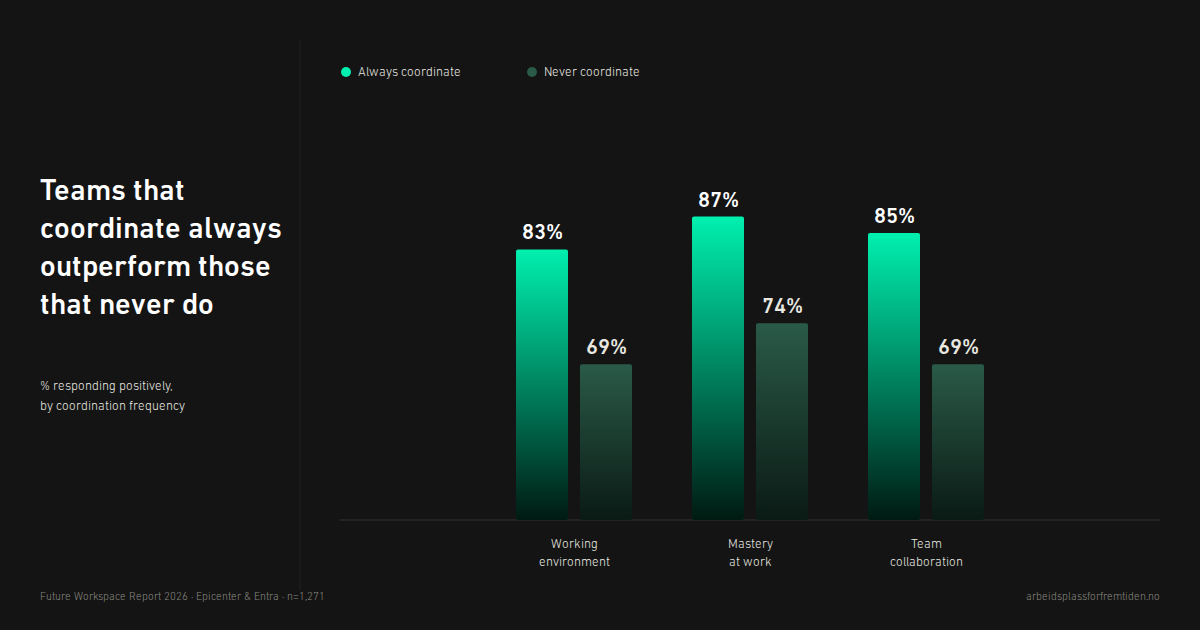
The coordination gap also reveals something about how leadership behaviour translates, or fails to translate, through an organisation. 54% of managers coordinate often or always. Only 28% of employees without management responsibility do the same. Leaders have built the habit for themselves. They have not embedded it as a team norm. That gap is manageable, but it requires intent.
At Epicenter, we see this pattern constantly in how our member companies use the space. The teams that show up with the most energy and the strongest culture are rarely the ones with the most mandated office days. They are the ones that have made being together a deliberate act. Most organisations are leaving one of the most powerful team performance levers completely to chance.
02 The office most people sit in was not designed for how they actually work
The office of 2026 needs to support two things simultaneously: uninterrupted concentration and the kind of in person collaboration that cannot happen on a screen. Most offices do not do either well.
60% of Oslo office workers say their office is poorly or only slightly adapted for concentration work. 54% say it is poorly or only slightly adapted for creative collaboration.
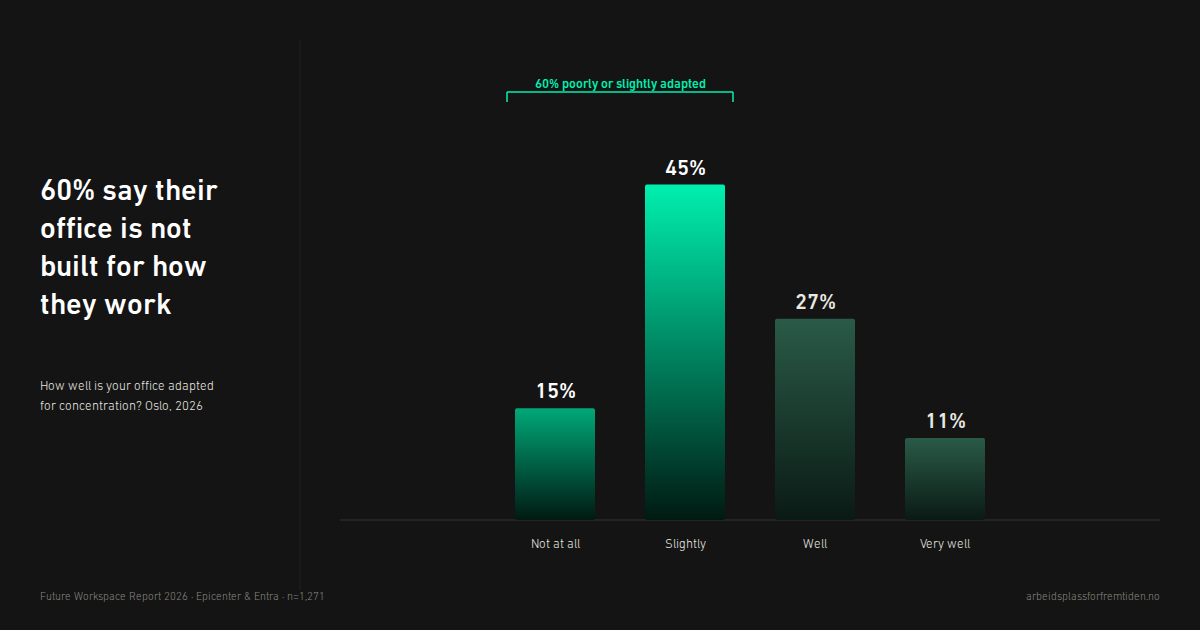
This matters whether you are a scaleup choosing your next space or an established organisation asking why attendance is lower than expected. The data is consistent: people are not staying home because they lack commitment. They are staying home because the office is not giving them what they need to do their best work. As AI raises the bar for what serious human work looks like, the gap between a well designed workspace and a poorly designed one will matter more, not less. When an office can genuinely support both deep concentration and in person collaboration, showing up becomes a choice people want to make.
If 60% of your team finds your office poorly suited for focused work, the problem is not their commitment. It is the space.
03 The AI paradox: the more digital we become, the more the human factors matter
36% of Oslo office workers now use AI daily. But adoption is uneven, the fears are misunderstood, and the gaps it is creating inside teams are only beginning to show.
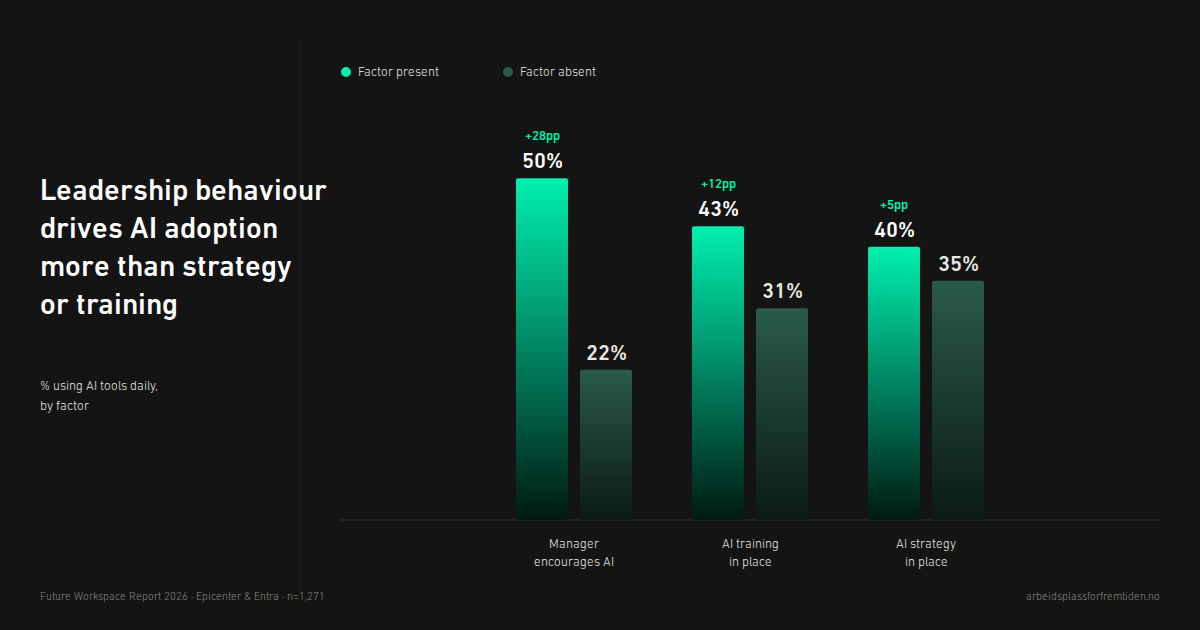
56% of Norwegian organisations have an AI strategy. When a leader actively encourages AI use, 50% of employees use it daily. When a leader does not, that drops to 22%.
That 28 percentage point gap is driven entirely by one person's behaviour. For comparison, having a formal AI strategy increases daily use by 5 percentage points. Training adds 12. Leadership behaviour moves the needle more than strategy and training combined.
The dominant public narrative about AI in the workplace centres on job replacement. The data from our survey tells a different story. Only 14% of employees cite job security as a primary concern about AI. The leading concern, at 57%, is errors and misuse in work processes. Among organisations that have experienced layoffs, 80% of employees say AI was not a significant cause. Employees are not afraid of being replaced. They are afraid of getting it wrong without enough support to get it right.
The practical consequence of uneven AI adoption is not job loss. It is internal fragmentation. When some team members are using AI fluently and others are not, knowledge concentrates, collaboration becomes more complicated, and the gap widens in ways that are hard to close later. 41% of private sector employees use AI daily, compared to 28% in the public sector. 45% of 23 to 34 year olds use it daily, compared to 33% of those aged 50 to 65. These are not technology gaps. They are culture and leadership gaps, and they compound over time.
The organisations that succeed with AI take the whole organisation with them. It starts at the top, with leaders who actually use the tools and create a culture where it is safe to test, fail, and learn together. Mathias Willumsen, Country Manager, Epicenter Oslo
04 Mental health at work: the leadership gap
Mental health has never been higher on the workplace agenda. And yet the gap between agenda and reality is significant. Only 33% of employees feel their workplace genuinely has a culture for talking about it openly, and leaders are finding it harder than most realise: only 18% say it is easy to follow up on psychological health challenges, compared to 48% for physical ones.
44% of employees say clearer workload expectations and priorities is the most important thing their employer could do for their mental health. Only 11% say it has been introduced. 27% want better support from their manager. Only 12% say it exists.
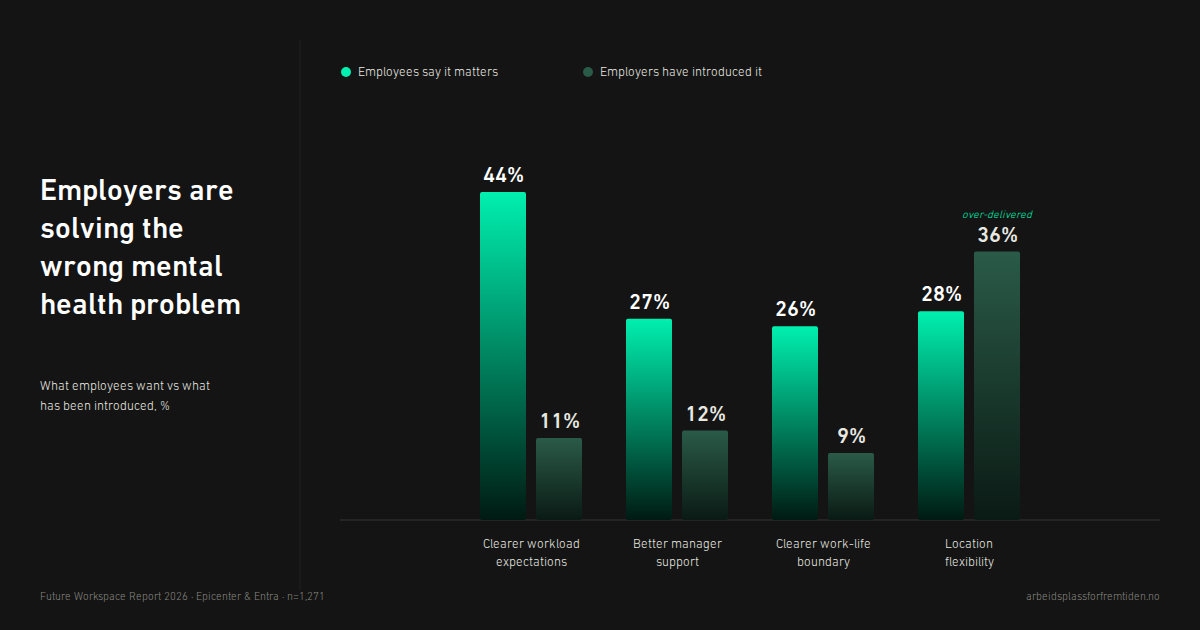
Leaders have a significant blind spot here. 53% of leaders believe their employees speak to them about psychological challenges before seeing a doctor. Only 43% of employees say they actually do. The gap is consistent: leaders overestimate how open and accessible they are. And it is the youngest employees who are paying the highest price. 28% of those aged 23 to 34 regularly experience psychological discomfort at work, compared to 17% of the oldest group, and only 11% of that youngest cohort have weekly one to one meetings with their manager.
One habit changes everything
The data on one to ones is the most consistent finding in the entire report. Among employees who have them weekly, 59% get good help managing their workload. Among those who never have them, the number falls to 17%. And the effect reaches further than mental health. The single most powerful driver of loyalty is something most organisations are not measuring or managing directly: the weekly one to one meeting. Among employees who have weekly one to ones with their manager, 65% have strong employer loyalty. Among those who rarely or never have them: 53%. One meeting per week. A 12 percentage point difference in loyalty across your entire workforce.
The thread that runs through all of it
Hybrid policy, office design, AI adoption, mental health culture. These are usually treated as four separate workstreams with four separate owners. The data from this year's report suggests the same question: are leaders creating the conditions for people to do their best work together?
That question does not get answered by a strategy document. It gets answered by leaders who coordinate deliberately, who design for how work actually happens, who model the behaviour they want to see with AI, and who show up consistently for the people they lead. The organisations getting this right are not doing four things well. They are doing one thing well, and it shows up everywhere.
The findings in this article are drawn from the Future Workspace Report 2026, produced by Epicenter and Entra. More in depth analysis of the data and findings will follow on our channels in the coming months.
Read the full report here (in Norwegian): www.arbeidsplassforfremtiden.no
FAQ
How many people were surveyed for the Future Workspace 2026 Report?
1,250+ office workers across the Oslo region.
What topics does the report cover?
Hybrid work coordination, office design, AI adoption, and mental health at work.
Who produced the report?
Epicenter and Entra, for the fourth consecutive year.
Where can I read the full report?
The full report is available in Norwegian at www.arbeidsplassforfremtiden.no.